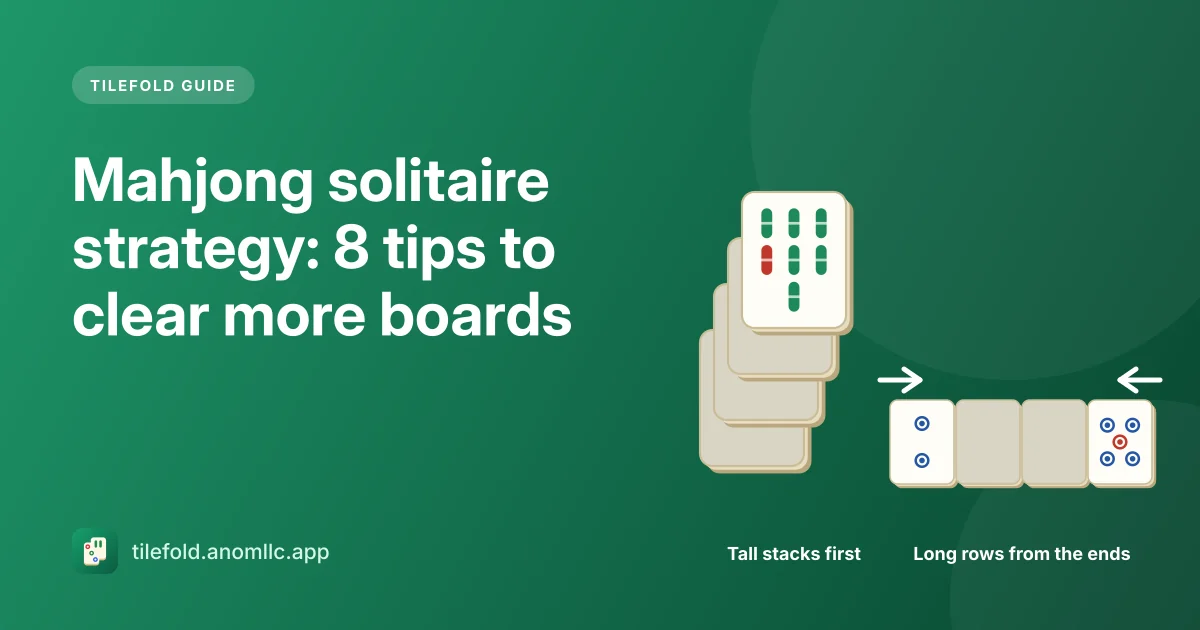
The key to mahjong solitaire is choosing which pair to take when you have a choice. The best pair is usually the one that frees the most tiles: tiles on top of tall stacks and at the ends of long rows. Avoid taking a pair just because it's there, and always count how many of that picture are left before you tap.
1. Clear the tall stacks first
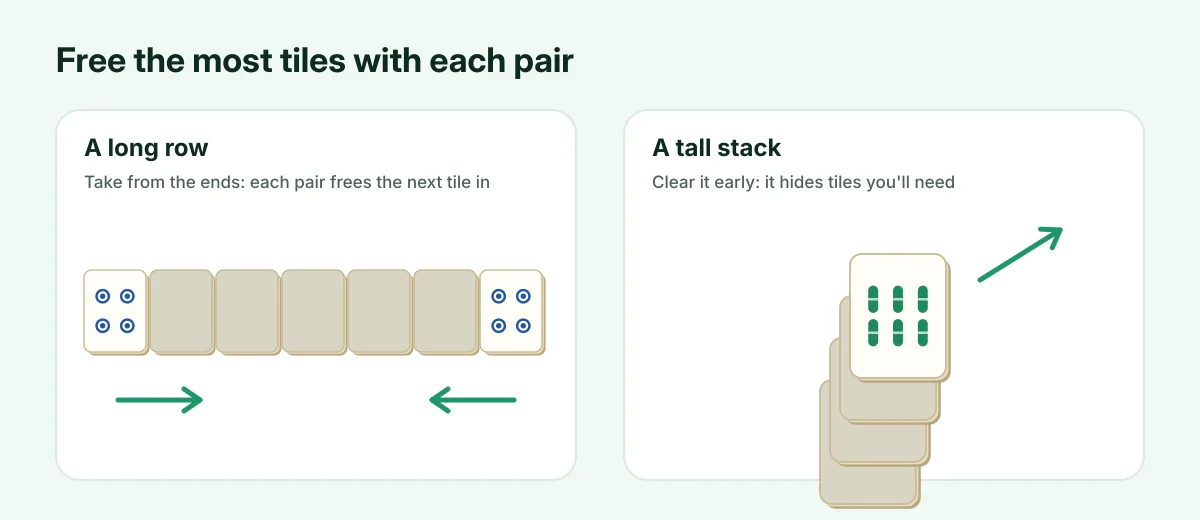
A stack of four or five tiles hides four or five layers of tiles that you can't reach. Taking the top tile opens the next one. Boards are lost when the last tiles of a picture are buried in the same stack, so work the stacks down early.
2. Open the long rows from the ends
In a row of twelve, only the two end tiles are free. Every pair you take from the end of a long row frees the next tile in. Prefer pairs from long rows over pairs from short ones.
3. Count the fours
Every picture comes four times. Before you take a pair, look at where the other two tiles are:
- All four free? Take both pairs.
- Three free, one buried? Take the pair that leaves free the tile that isn't blocking anything; the third waits for the fourth.
- Two free, two buried in the same stack, one on top of the other? Be careful: if you use the free two elsewhere, the buried two can only match each other, and one is under the other. That's the classic way to get stuck.
4. Don't take a pair just because you can
If a pair blocks nothing, there's no hurry. Leave it until you need it; it may be the only move left later.
5. Watch the flowers and seasons
Any flower matches any flower, and any season any season. That makes them flexible: save them for when a flower or season is the tile blocking a stack.
6. Use undo to test, not to rescue
Undo is unlimited in Tilefold. Use it to try a line of moves and see what it opens. If a pair frees nothing useful, undo and try the other one.
7. Shuffle at the right time
A shuffle rearranges the tiles left on the board, keeping their positions. It's most useful late in a level, when a few stacks are left and no pairs are free. Early on, there are usually still good moves to find. Tilefold gives 2 free shuffles per level; after that, a short video gives one more.
8. Let the hint teach you
Tilefold's hint shows a pair and, when it can, picks one that keeps the board clearable. If you're stuck, take a hint and ask yourself why that pair: it usually uncovers a stack or opens a row. You get 3 free hints per level.
Practise on the small layouts
Tilefold's first ten levels go through all ten layouts, from small boards like Square and Arch to the big Grand layout, and later levels keep cycling through them. The small ones are perfect for practising these habits; the big ones reward them. And since every level is dealt so it can be cleared, a board that ends stuck always has a better line to find with undo.
New to the rules? Read how to play mahjong solitaire first.