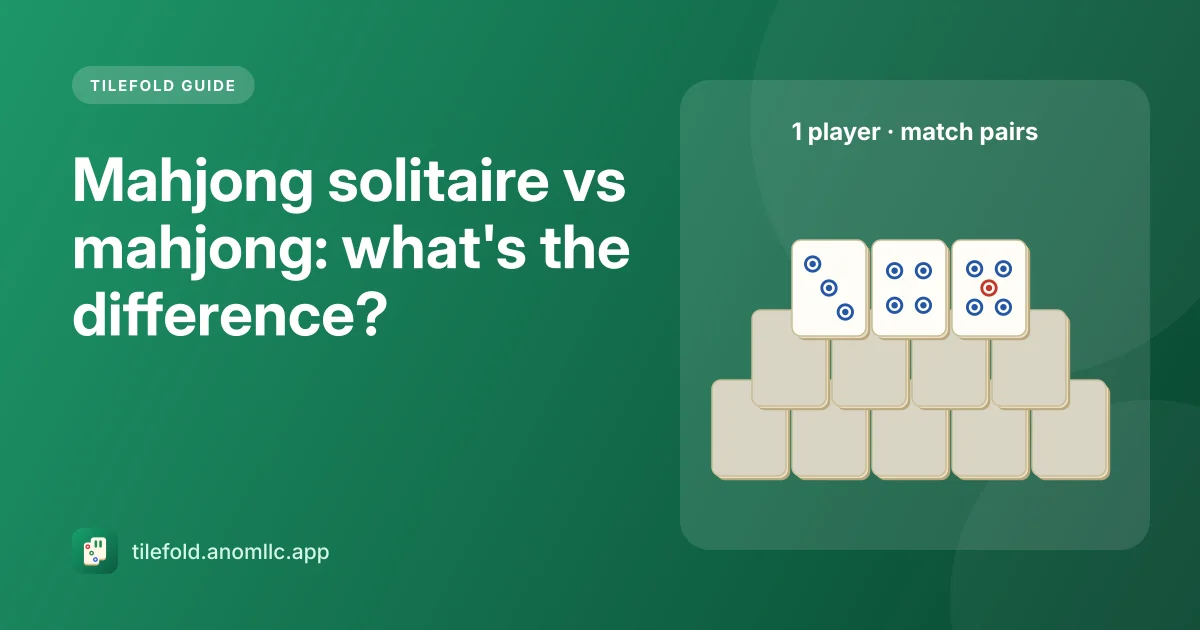
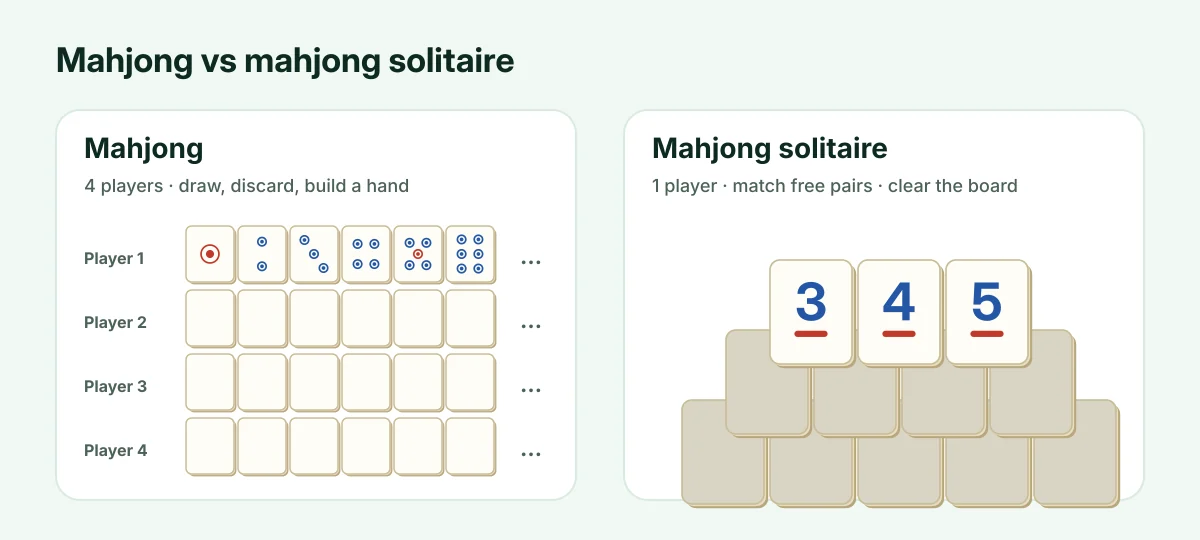
Mahjong is a four-player game from China in which players draw and discard tiles to build a winning hand, a bit like rummy. Mahjong solitaire is a one-player matching game that uses the same tiles: you remove matching pairs of free tiles from a stacked layout until the board is clear. They share the tiles, but the rules, the skills and the feel are completely different.
At a glance
| Mahjong | Mahjong solitaire | |
|---|---|---|
| Players | 4 (some versions 3) | 1 |
| Goal | Build a winning hand of sets and a pair | Remove every tile from the board |
| Tiles | 136 or 144, shuffled into a wall | 144 (or fewer on small layouts), stacked in a layout |
| A turn | Draw a tile, discard a tile | Tap two matching free tiles |
| Skill | Reading other players, probability, scoring | Spotting free tiles, planning which pair to take |
| Chance | High: the draw decides a lot | The deal is fixed; your choices decide |
| Scoring | Detailed and varies by region | Usually just time or moves |
How four-player mahjong works
Each player holds 13 tiles. On your turn you draw one and discard one, aiming for a complete hand: usually four sets (three of a kind, or three in a row in one suit) plus a pair. You can claim another player's discard to complete a set. Rules and scoring vary a lot between Chinese, Hong Kong, Japanese (riichi) and American versions. In many places, it's also played for money, which is one reason it's sometimes confused with gambling games.
How mahjong solitaire works
The tiles are laid face up in a layered shape. A tile is free when nothing is on top of it and its left or right side is open. Match two free tiles with the same picture and they're removed; any flower matches any flower and any season any season. Clear the board to win. There are no opponents, no hands, and nothing is bet. See how to play mahjong solitaire for the full rules.
The game was made popular on computers in the 1980s, and today "mahjong" in an app store usually means this solitaire version.
Which one is Tilefold?
Tilefold is mahjong solitaire: one player, matching pairs, ten layouts and no betting of any kind. Hints, shuffles and undo help when you're stuck, and every level is dealt so that it can be cleared. If you've played four-player mahjong, you'll recognise every tile; the mahjong tiles guide shows them all.
Can learning one help with the other?
A little. Knowing the tiles makes mahjong solitaire faster, because you'll read suits and honours at a glance. But the strategies don't carry over: solitaire is about uncovering tiles in the right order (our strategy tips explain how), while the four-player game is about building hands and reading the table.